GroundworkTH
UI tests written as plain sentences, run by a language model against a real desktop app, with evidence for every step.
- status
- in use for the UI tests of real Tauri apps on macOS
- language
- TypeScript on Node.js, WebdriverIO, a native macOS helper
- license
- MIT
The problem
Applications need testing. Not everything can be tested by unit or integration tests only, especially UIs. Frameworks for automated UI and end-to-end testing are either expensive, hard to learn, hard to maintain, unreliable or a combination of all of it.
Manual UI testing is not much better: done correctly it is extremely time-consuming. A well-executed, well-documented manual test case is something that takes a lot of effort. Not once, but every time the test is done.
In my experience, in a private project, these tests are the first thing that falls behind.
An idea for a solution
LLMs have become great at understanding human language and human intention. Agent harnesses are getting more and more powerful and enable AI agents to act in clever ways to reach their goals.
GroundworkTH is my answer to the question of how an LLM clamped into a testing harness can provide flexible, nearly automatic test coverage in end-to-end testing.
What it does
A test is a list of steps, each one written in a way a tester would write them to have another human execute them. The example below shows a simple test written for TrunkDB Admin for a basic filter condition. @open-people is a group of steps several tests share.
{
  "name": "filter-by-city",
  "steps": [
    "@open-people",
    "Add a filter condition.",
    "Type address.city into the field path of condition 1.",
    "Type Berlin into the value of condition 1.",
    "Run the filter.",
    "Assert that 46 documents are listed."
  ]
}
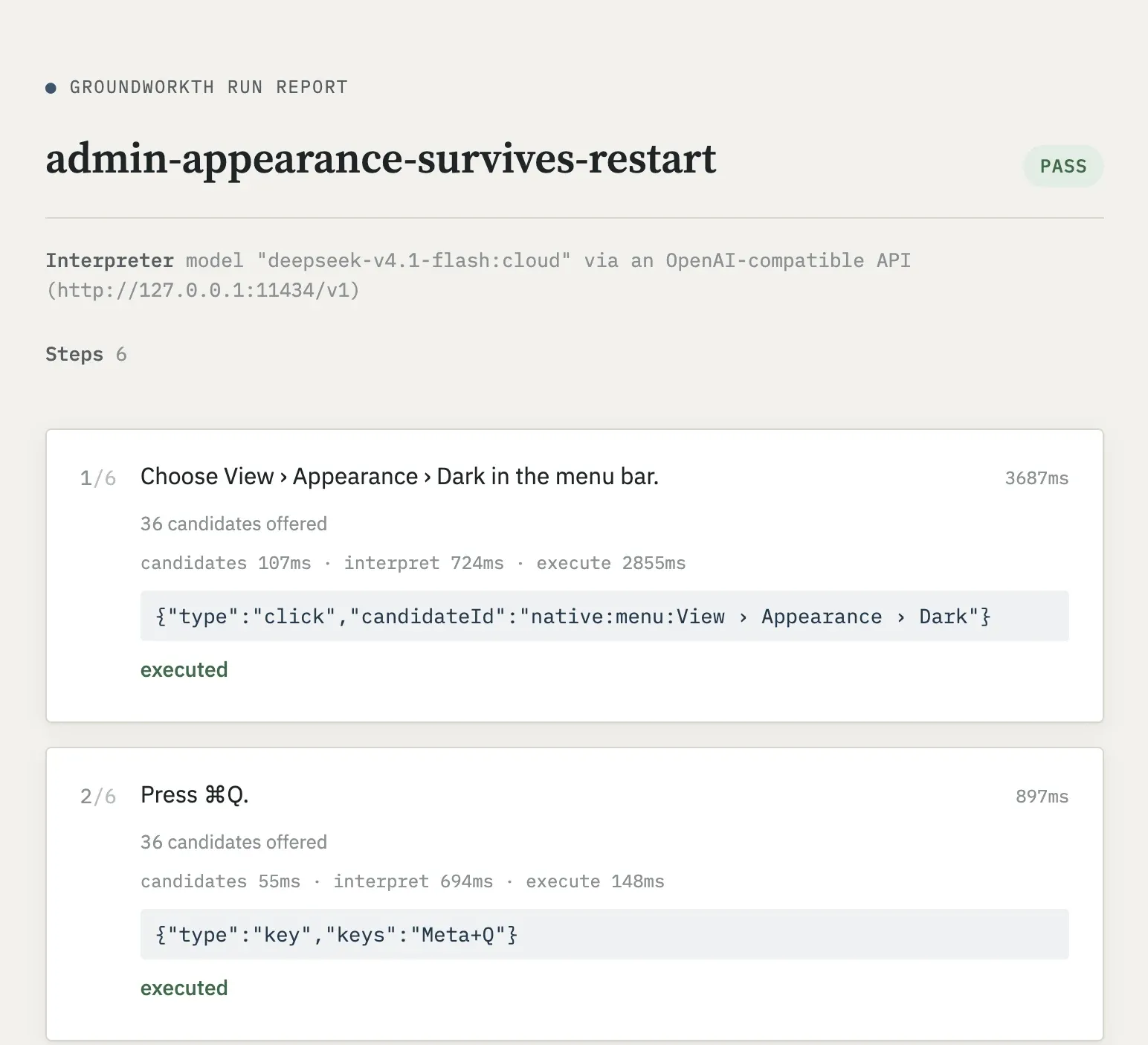
For each step, the harness lists what is on screen (buttons, fields, texts, each named as a screen reader names it) and asks the model which one the step means and what to do with it. Everything is recorded: the candidates offered, the model's raw answer, what was done, the evidence for each assertion, screenshots, and an HTML report.
A test can end with checks outside the app, the way a person checks in Finder or a terminal, so "Cancel changes nothing" is a test too:
{
  "name": "open-cancel-changes-nothing",
  "steps": ["Click \"Open database…\".", "Click Cancel."],
  "after": [
    { "unchanged": "${GROUNDWORK_RUN_DIR}/sample.trunkdb" },
    { "absent": "${GROUNDWORK_RUN_DIR}/untitled.trunkdb" }
  ]
}
A native macOS helper reaches what WebDriver cannot: open and save panels, alerts, the menu bar, the Dock, real keystrokes. Steps about how something looks ("the window is dark and its text readable") are checked on a screenshot by a vision model.
# all tests, as one run
groundwork run

# just this one
groundwork run filter-by-city

# one suite
groundwork run --suite smoke

# record, run and review at http://127.0.0.1:4500
groundwork dashboard
Key decisions
The model never sees a selector or a coordinate
It gets a list of candidates, each an id for this snapshot, a text and a role, and answers with one action from a small schema: click, fill, select, key, scroll, wait_for, dismiss or assert. The harness validates the answer before anything happens. An answer it can't use gets one corrective prompt; a step that still can't be interpreted stops the run instead of guessing. And "nothing here matches" is an allowed answer, which fails the step with that reason.
The model states the claim, the harness compares
For "Assert that 46 documents are listed", the model copies "46 documents" from the step, not from the screen, and the harness checks it against what is shown. A test can also be a negative control: a claim that is false on purpose, such as a count off by one, which passes only if the run fails on it. It shows the check can fail at all.
One boundary
The orchestrator knows tests, steps, traces and reports, and never imports anything app-specific. An adapter per kind of app supplies candidates and carries out actions, with four methods. There is one for Tauri apps; Windows and Linux would each need a native helper of their own behind the same commands.
Flexible model selection
Every tester can select their own preferred model to find a balance between reliability and costs.
Recording sessions
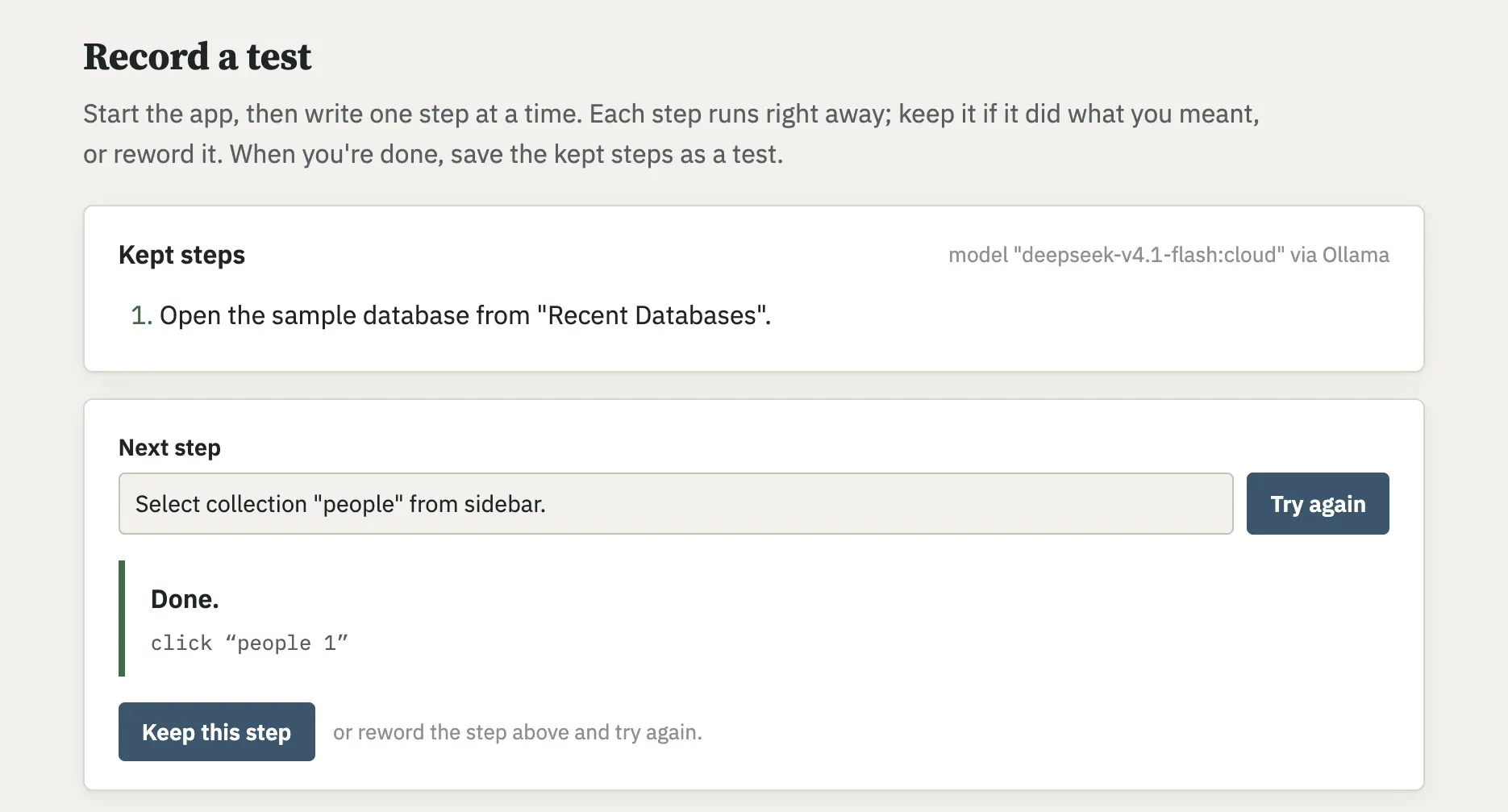
Test steps can be live recorded to verify the action the model takes for a specific step until the result fits the tester's expectation.
Status
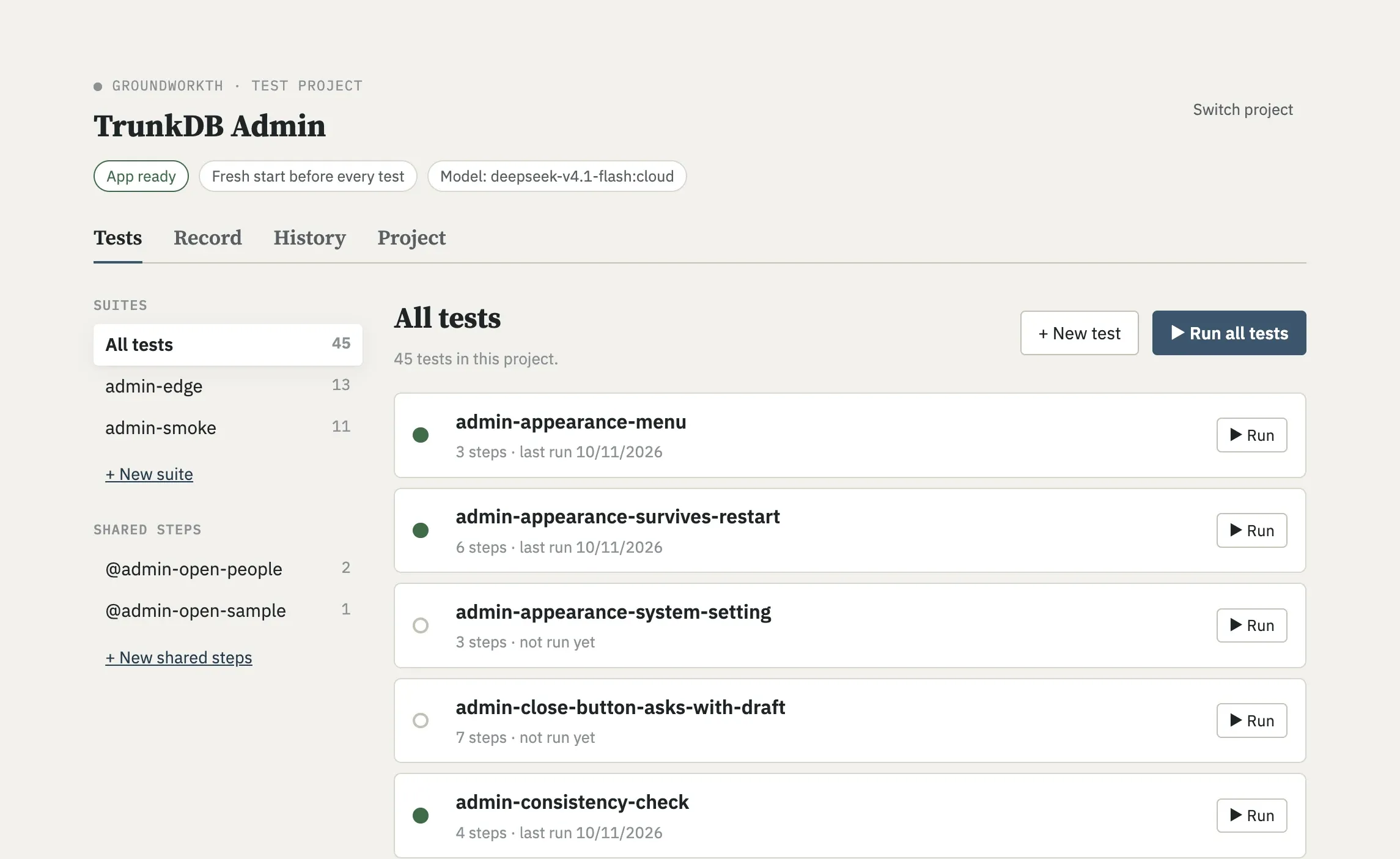
In use for the UI tests of Tauri apps on macOS, among them TrunkDB Admin, whose test project shows tests, shared steps and suites in practice.
What was measured so far:
- Consistent: repeatable results over hundreds of test steps.
- A step takes only about as long as the model call: 4–6 seconds with a cloud model.
- Small local models handle ordinary steps; negative controls are the hard part.
Known limits: it runs on macOS only, the one adapter so far is for Tauri apps built with the WebDriver plugin, and it needs a model, local or in the cloud.
One more word about model selection
I tried different models for the harness: locally hosted LLMs up to 27b parameters, cloud hosted LLMs from different vendors as well as some decision models. Different models came with their own pros and cons and I can just encourage everyone to try for themselves which model fits best for their case, but I made two general realizations:
- the bigger the model the better the results
- decision models had no benefit over LLMs
The second one was kind of surprising to me. Maybe the decision models available to me just had the disadvantage of size, but I was kind of disappointed by their performance. Following this recognition, support for decision models has been postponed.